



Hi there,
Good news, dear friends. WordPress 7.0 has a new release date! May 20, 2026. Announced on Friday, the post featured the updated release party schedule: All release parties happen in the Make #core Slack channel. Everyone is welcome to join.
This week, I also traveled to Salzburg, Austria to discuss WordPress 7.0 features with the local community. It was a great joy to meet so many fellow community organizers from WordCamps Vienna, Europe and Kampala, as well as the local meetup organizers and participants from Salzburg.
Enjoy the hopefully restful weekend.
Yours, 
Birgit
Developing Gutenberg and WordPress
Ray Morey, The Repository has the skinny about WordPress 7.0 Gets a New May 20 Release Date
Jonathan Desrosiers and Max Schmeling of the WordPress Core team has published Distributed RTC performance testing, a bash/PHP load-testing tool for the real-time collaboration HTTP polling endpoint coming in WordPress 7.0. Hosting providers can run scenarios — baseline, single idle, sustained polling, burst concurrency, and two-client editing — then submit results directly to WordPress.org. Only curl and bash are required, with WP-CLI optional. If you’re a host and need reporting credentials, ping Jonathan Desrosiers (@desrosj) or Amy Kamala (@amykamala) in the #hosting Slack channel.
JuanMa Garrido introduces the WordPress Core Dev Environment Toolkit, a desktop app for macOS, Windows, and Linux that eliminates the painful setup that burns through Contributor Days before anyone writes a line of code. Powered by WordPress Playground, it bundles Git, Node, and npm as JS/WASM — so you install the app, click a button, and you’re cloning wordpress-develop, running a dev server, and generating Trac patches without touching a terminal.
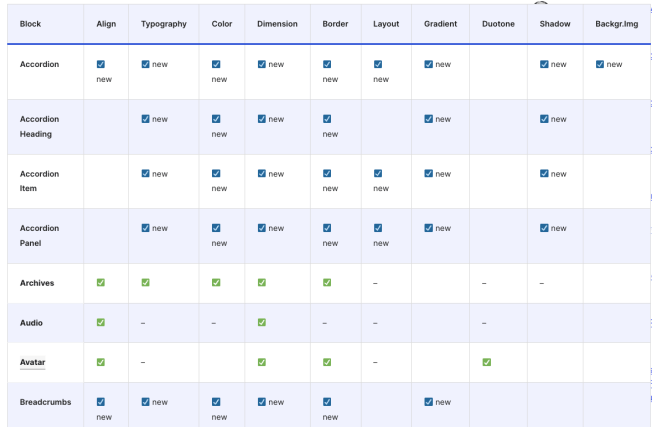
The latest Dev note arrival brings you Roster of design tools per block (WordPress 7.0 edition). I updated a previous version for WordPress 7.0, summarizing design support changes across the last ten releases. WordPress 7.0 adds seven new blocks — Accordion, Breadcrumbs, Icon, Math, Post Time to Read, and the Term Query family — and renames Verse to Poetry. I also removed the Pattern Overrides/Block Bindings column, since both features are now opt-in per block and attribute, making a single checkbox no longer meaningful.

Gutenberg 23.0 ships a revisions panel for templates, template parts, and patterns (experimental), and completes the Site Editor’s Design › Identity panel with Site Title and Tagline fields alongside the existing Logo and Icon. Real-time collaboration gets legacy meta box compatibility via a new opt-in flag, plus reliability fixes for concurrent edits and corrupted sync updates. 174 PRs merged, with 8 first-time contributors.
For the Gutenberg Changelog episode 130, Tammie Lister and I chatted about AI in Art and WordPress, WordPress 7.0 and Real-tine collaboration and Gutenberg plugin release 22.9 and 23.0. The episode will drop in your favorite podcast episode over the weekend. I hope you listen in and enjoy our conversation.

 The latest episode is Gutenberg Changelog #129 Artificial Intelligence, WordPress 7.0 and Gutenberg 22.8 with Beth Soderberg, of BeThink Studio

Plugins, Themes, and Tools for #nocode site builders and owners
Brian Coords, developer advocate at WooCommerce, walks you through a prototype plugin called WP Content Types, a block-native take on custom post types and fields built directly into the WordPress interface using Data Views and Data Forms. You’ll see AI generate a Recipe content type, configure fields with core components, connect templates through block bindings, and explore a “Fields Only” modern UI. It’s a V1 vision for content modeling that leaves legacy backwards compatibility behind.
Coords implementation goes much further than a similar project “Create Content Model” Autumn Fjeld and Candy Tsai demo’d at WordCamp Asia 2025 in Manila, Philippines. Their repo is available on GitHub including links to the talk and demo video.
In his latest video, Wes Theron walks you through using block dimensions to control layout in WordPress — without touching any CSS. You’ll learn how to find the dimensions panel in the editor and learn when to reach for padding (space inside a block), margin (space around it), block spacing (gaps between child blocks), and minimum height. Each setting gets a practical demo so you can confidently build cleaner, more polished pages with better visual hierarchy.
Alex de Borba makes a pointed case in Why Developers Keep Reaching for Builders Over Block Themes that the “block themes can’t compete” narrative is more habit than fact. With theme.json v3, register_block_style(), synced patterns, and wp_enqueue_block_style(), you can build design systems, reusable components, and performant layouts without proprietary tools — and without locking your clients into someone else’s ecosystem when developer relationships change.
At WordCamp Asia, the WordPress Speed Build Challenge returned for a second round: experienced builders had 30 minutes, a surprise brief revealed live on stage, and nothing but the Full Site Editor — no page builders, no custom code. Watch how they tackle layout, content, styling, and real-time problem-solving under pressure while narrating their decisions. A fun, unscripted window into smart site editor workflows for anyone curious about block-based building. The recording is now available on WordPressTV.
Upcoming Events
The 6th annual Web Agency Summit runs April 27–30, 2026. It’s free, virtual, and built for agency owners ready to stop winging it. Hosted by Vito Peleg, Stephanie Hudson, and Andrew Palmer, four days of live expert sessions cover the full agency arc: Build, Expand, Scale, and Thrive. Speakers include Eugene Levin from Semrush and Karim Marucchi of Crowd Favorite. Think of it as a week-long podcast you keep open while you work.
If you’re in New York on April 29, dev/ai/nyc with Hilary Mason is worth your evening. Hilary Mason — CEO of Hidden Door, founder of Fast Forward Labs, and former Chief Scientist at bit.ly — joins Jesse Friedman, who leads WP Cloud at Automattic, for a fireside chat on AI, creativity, and human-computer interaction. Doors open at 5:30 PM at Automattic’s NoHo space on Crosby Street, with drinks and bites after. Registration is on Luma. The event is free of charge.
The Checkout Summit in-person event just wrapped up in Palermo, Sicily — don’t be sad you missed the arancine and Aperol Spritz. Organizer Rodolfo Melogli of Business Bloomer will reassemble 18+ speakers for the online edition, {Reloaded}, on May 7–8, 2026 starting at just €20. The WooCommerce-focused lineup covers SEO after AI, MCP integrations, hosting security, Shopify comparisons, and scaling strategies — practical sessions, zero fluff, built for developers and agency pros.
Rae Morey, The Repository has the skinny for you in Can’t Make It to Palermo? Checkout Summit Is Going Online in May.
Uganda’s biggest annual student web design competition, Website Projects Competition 2026, takes place on June 9, 2026 at Busoga College, Mwiri. Under the theme “Fueling Innovation Through WordPress,” 20 student teams across three age categories — Cubs (12 & under), Rising Stars (13–18), and Explorers (18+) — compete by building and pitching WordPress websites to a live audience of 200+. Sponsored by Automattic and Woo. Registration and sponsorship are open.
WordPress Accessibility Day 2026 is a free, 24-hour global livestream on October 7–8, 2026, dedicated to accessibility best practices for WordPress developers, designers, and content creators. The volunteer-led nonprofit event includes live captions and ASL interpretation for all sessions, with corrected transcripts published afterward. It’s pre-approved for IAAP continuing education credits. Sponsorships are now open, ranging from $150 Microsponsors to $5,000 Platinum packages.
Theme Development for Full Site Editing and Blocks
Gina Lucia, freelance writer, published a beginner-friendly walkthrough on what WordPress block patterns are and how to use them for OllieWP. You’ll learn how patterns differ from synced patterns, templates, and template parts, why block themes unlock their full potential for headers, footers, and full-page layouts, and how to browse, preview, insert, and customize curated patterns in Ollie’s pattern library. A handy primer if you’re moving from classic themes into the full site editing experience.
Nathan Wrigley sits down with Brian Gardner to talk block themes, AI, and the future of WordPress design. The Genesis co-creator argues that many developers are still judging the block editor by a five-year-old experience — and missing how far it’s come. He shares his work on Powder, explores how tools like Ollie and Miles are bridging AI-generated design with native WordPress blocks, and asks the question keeping him up at night: do we still need hundreds of themes, or is one solid base theme plus vertical-specific patterns actually the future?
JC Palmes, WebDev Studios and regular guest on the Gutenberg Changelog, makes the case that block themes can replace one-off chaos with repeatable consistency on large team projects. The approach: start with a shared starter theme, build a reusable pattern library, and centralize design decisions in theme.json. She also tackles the less glamorous side — onboarding developers, running QA, and finding the right balance between editorial freedom and long-term maintainability. Practical and team-focused, it’s a playbook worth your time if you’re managing multi-site or multi-developer WordPress work.
Anne Katzeff walks you through using the Cover block as a Hero section with a Call to Action. Starting from default settings, she shows how alignment (wide or full width), overlay color and opacity, minimum height, focal point, and inner block layout work together to create a polished hero.
Katzeff also created a companion video tutorial to follow along with how she manipulates the cover block for her purposes. All very practical and beginner-friendly.
Building Blocks and Tools for the Block editor.
AI in WordPress
Automattic’s head of global expansion James Grierson argues in WordPress: The Operating System of the Agentic Web that WordPress’s open-source transparency, 90,000+ plugin ecosystem, REST API, and MCP support make it the ideal foundation for AI agents. WordPress.com’s full MCP write capabilities — launched in March 2026—let agents create and manage content via natural conversation. Challenges remain around legacy code, inconsistent plugin quality, and PHP perception, but Grierson sees AI itself as the solution to those very problems.
Inspired by a trip to WordCamp Asia 2026 in Mumbai, Chandra Patel built the WordPress REST API Playground — a free plugin developed entirely with Claude Code in just 2–3 hours. The three-panel interface lets you browse all registered REST API routes, build requests with schema-driven form fields, and view syntax-highlighted responses with timing info. A handy Code tab generates ready-to-use JavaScript, PHP, and cURL snippets for every request. Available on GitHub.
Pablo Postigo used Studio Code, Automattic’s new AI coding agent for building WordPress sites locally, to finally redesign Govoid.es, a geek news blog he co-founded in 2009 that’s been dormant since 2013. He used Claude to craft a detailed design brief, fed it to Studio Code (running Claude Opus 4.7), and got a complete minimalist dark-mode block theme generated in one shot, with only a couple of hours of refinement before pushing straight to production. Studio Code is still in alpha, there will be dragons 

Questions? Suggestions? Ideas?
Don’t hesitate to send them via email or
send me a message on WordPress Slack or Twitter @bph.
For questions to be answered on the Gutenberg Changelog,
send them to changelog@gutenbergtimes.com