


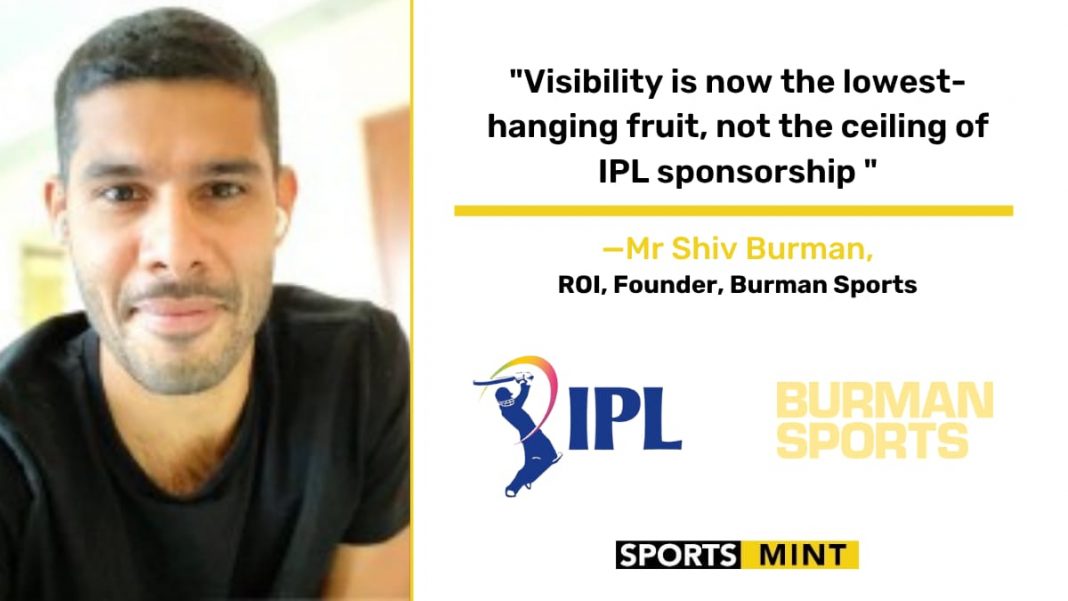

The post EXCLUSIVE: Visibility is now the lowest-hanging fruit, not the ceiling of IPL sponsorship ROI — Shiv Burman, Founder, Burman Sports appeared first on SportsMint Media.
The Indian Premier League (IPL) has grown into one of the world’s most effective sports marketing platforms, drawing not just conventional cricket sponsors but also an increasing number of non-endemic corporations seeking to strengthen customer relationships. As competition for sponsorship inventory heats up and companies want verifiable business results, IPL ecosystem collaborations have become significantly more strategic, data-driven, and activation-led.
In this exclusive interview with SportsMint Media, Shiv Burman, Founder -Burman Sports, discusses the changing dynamics of IPL sponsorships, the rise of long-term brand associations, the role of fan insights in campaign design, and how brands like Netflix, Malaysia Airlines, DP World, and Marriott Bonvoy are using cricket to drive tangible business impact. The discussion also delves into shifting ROI measurements, collaboration planning, and the commercial future of one of the world’s most valuable sports assets.
1. The IPL ecosystem has evolved significantly in recent years. How has the nature of brand partnerships changed, particularly with more non-endemic brands entering the space?
The most significant shift we’ve witnessed is a move from transactional to transformational. IPL used to be a visibility play, brands wanted logo space and a broadcaster-certified reach number. That’s changed fundamentally. Brands like Malaysia Airlines, Netflix, and DP World aren’t just buying space in the ecosystem, they’re using it to drive cultural relevance and measurable business outcomes in India. The evolved marketers are now seeing partnerships as a strategic growth lever, not only a reach platform. Non-endemic brands are often the ones who approach this most seriously, because they are the ones who need to find a role that resonates with fans. That means they want a clear strategic rationale, a defined audience thesis, and an activation architecture that actually works. That, frankly, is raising the bar across the board.
2. What was the core brief behind bringing brands like Netflix, Malaysia Airlines, and DP World into IPL franchises? How do you identify the right brand–team fit across such diverse sectors?
Each of these partnerships started with a genuine business challenge or outcome in mind. With Malaysia Airlines, the ambition was to build cultural salience and commercial momentum in India , a priority market served by 80 weekly flights across ten cities. Visibility alone wouldn’t do that. Brand values, scale, market positioning, and engaging with the experience seeking audience, were the four areas of alignment. The value piece was actually the most compelling. Mumbai Indians’ “one family” mantra and Malaysia Airlines’s purpose of “Malaysian hospitality begins with us” are both built around the same idea: that the people you serve are at the centre of everything. With Netflix, the insight was behavioural. IPL players spend over two months on the road, in hotels, in long stretches between matches and Netflix was already their go-to in that downtime. We identified that as a genuinely ownable, authentic space, built a bespoke rights sheet, and positioned Netflix as the Official Entertainment Partner across IPL franchises boosted by individual deals with Rohit Shrama , Hardik Pandya etc. That became ‘Chill Like a Champion’ Netflix’s first ever partnerships in the IPL. For DP World, we started 4 years back with a landscape analysis mapped against their global business and comms strategy but with a customised approach to India. DP World has a very evolved partnerships strategy when compared to other brands investing in sport in India. We understood that strategy deeply and with our friends at 160over90 put together a comms and activation strategy across cricket and specifically the sub-con.
3. We’re seeing a shift from short-term visibility plays to long-term strategic associations. How real is this shift, and what’s driving it?
The IPL’s commercial maturity has a lot to do with it – the supply demand dynamics have shifted over the last few years. There are lesser assets available and more brands competing for them. The brands driving this shift are the ones who’ve seen the difference between renting space and owning a narrative. Brands that entered early and committed and showed up every season, built fan equity and recall – they are now seeing compounding returns. That’s hard to ignore. In contrast, brands that came in for a season, ran a tactical campaign, and left have very little to show for it. What’s also driving it is the increasing sophistication of measurement – brands can demonstrate that a multi-season association moved brand preference, drove app downloads, or converted fan affinity into commercial outcomes, the conversation with the CFO changes. It stops being a cost and starts being an investment thesis. At Burman Sports, we actively push for longer engagements not because it’s better for our business, but because it genuinely produces better work. The activation calendar gets sharper, the storytelling gets richer, and the brand has time to become a genuine part of fan culture rather than a logo that appeared for eight weeks.
4. Campaigns today appear far more structured and insight-led. How early do you begin planning IPL partnerships, and what does the typical roadmap look like?
We typically begin planning six to nine months before the season opens. The reason is simple the best inventory goes early, and more importantly, meaningful activation takes time to build. The roadmap follows a clear arc. We start with the strategic brief: what is the brand trying to achieve, and does sport , specifically IPL address that objective better than any other platform? If the answer is yes, we move to the rights landscape: which franchises, which formats, which assets align to the brief. From there, we build the partnership structure and begin negotiations. But the work doesn’t stop at the rights sheet. Simultaneously, we’re developing the activation architecture – the platform idea, the content calendar, the on-ground experience design, the talent strategy, and the digital amplification plan. By the time the season starts, we want every team, every agency, every stakeholder already in motion. What we’ve learned is that the brands that plan earliest have the most creative freedom. They’re not scrambling for assets or approvals mid-season. They’re executing against a plan they built months ago, and that shows in the quality of the output.
5. What role do consumer data and fan segmentation play in shaping these partnerships and campaigns?
Data and fan insights inform almost every decision we make, from the initial brief to activation design to real-time optimisation during the season. Our philosophy is fan-first thinking. We spend time understanding how sport is actually consumed today — not just who watches, but how they engage, what they care about beyond the match, and what white spaces exist in the fan experience that a brand can authentically occupy.
For the Naukri.com campaign with RCB, for instance, the insight was that cricket fandom is deeply community-driven and highly participatory. Rather than a conventional sponsorship, we created a ‘Coolest Job Ever’ concept, the ‘Fan in Chief’, that invited fans to lean in. The result was over 110,000 job applications for a fictional role, 3 million page views on the listing, and 2,200-plus pieces of UGC. That came from understanding the audience, not just the asset inventory.
This kind of thinking is reinforced by our partnership with Generate Digital, co-founded by Alex Balfour, Digital Lead of the London 2012 Olympics and co-founder of CricInfo. They bring digital valuation, performance benchmarking, and audience intelligence — understanding not just what a digital asset is worth, but who it reaches and how those fans behave. For rights holders, a clearer picture of their fan base. For brands, evidence of exactly which audiences a partnership unlocks and whether the investment is delivering.
Segmentation shapes how we think about franchise fit. Different franchises carry different fan demographics, emotional equity, and geographic strongholds. We match brands to properties based on those profiles, not just team performance or media metrics, and Generate Digital’s data layer can turn that matching from instinct into evidence, tracked before, during, and after a campaign.
6. Can you walk us through the lifecycle of a deal, from initial pitch to execution and activation?
We represent brands investing in sport. So, it starts with diagnosis. Before any pitch, we invest time understanding the brand’s business context, what they’re trying to solve, who their customer is, and why sport might be the right vehicle. If we don’t believe there’s a genuine fit, we’ll say so. Once the brief is clear, we move to landscape mapping – identifying which rights holders, formats, and asset types are best placed to deliver against the brief. This is where our ecosystem depth matters. Because we work across franchises, the ICC, talent, and content platforms, we can construct multi-layered proposals that go beyond standard team sponsorship packages. The pitch sets out the strategic rationale, the recommended partnership structure, and an outline activation concept. If the brand is aligned, we move into rights negotiations, which we handle in full, from initial term sheets through to final contracts. Post-deal, the activation phase begins. This is where we spend the bulk of our energy. We build the strategic positioning, asset optimisation plans, creative platform, manage the stakeholder relationships, oversee agency partners, and stay embedded through the live season to make real-time decisions. We’re not a firm that closes the deal and walks away , our work genuinely begins once the contract is signed.
7. How are brands measuring ROI in IPL partnerships today? Has the focus shifted from visibility to deeper engagement and business metrics?
The shift is unmistakable, and honestly, it’s long overdue. For too long, IPL sponsorship ROI was measured almost exclusively through broadcast metrics, equivalent ad value, and logo screen time. Those are blunt instruments. They tell you how many people potentially saw your brand; they tell you nothing about whether it changed behaviour or moved a business needle. The brands we work with now come with much sharper KPI frameworks. Engagement rates and content performance. Brand preference is lifted and measured through pre- and post-season research. App downloads, site traffic, and commercial conversion. Some are tracking direct revenue -ticket sales co-branded with the franchise and fan offers that are redeemable and traceable. For the Marriott Bonvoy partnership, for example, we created ‘money-can’t-buy’ experiences, pitch access at the Wankhede, anthem kid participation, the Golden Ticket Sweepstakes for the ICC T20 World Cup final, etc., that were explicitly designed to drive membership sign-ups and brand preference among high-value travellers. That’s a completely different measurement conversation to broadcast equivalence. Visibility still matters, but it’s now the lowest hanging fruit, not the ceiling.
8. With increasing competition for sponsorship inventory, how do you see pricing and value evolving within the IPL ecosystem?
Pricing will continue to rise, the demand side is expanding faster than the supply of premium inventory, and that dynamic isn’t changing anytime soon. The IPL’s global media rights growth, the growing fan base globally, and the increasing interest from international brands mean that competition for top-tier assets will only intensify. But the more interesting question is how value is being redefined. We’re moving past the era where price was simply a function of reach or eyeballs. Brands are increasingly willing to pay a premium for the right strategic fit, for early access to planning, and for activation support that actually delivers outcomes. This is where we see smaller or mid-tier inventory becoming increasingly interesting. The category exclusivity available in non-traditional segments represents real value at a fraction of the cost of a lead shirt sponsorship. It requires creativity and insight to unlock that value, but it’s there. The brands that will win in this environment are the ones that plan early, commit to multi-year relationships, and invest in activation, not just acquisition. Inventory is only as valuable as what you do with it.
The post EXCLUSIVE: Visibility is now the lowest-hanging fruit, not the ceiling of IPL sponsorship ROI — Shiv Burman, Founder, Burman Sports appeared first on SportsMint Media.